Harry and Tyrone's trip to Miami
Requiem for a DreamHarry and Tyrone’s trip to Miami begins as a desperate attempt to escape New York City’s Heroin shortage, but the southbound drive turns their promise of a quick, profitable solution into a passage through pain, racial hostility, and arrest. They leave believing that one bold trip will let them return with a large supply and end their dependence on the city’s increasingly dangerous street scramble; instead, the farther they travel, the less control they have over their bodies, their plans, or their destination.
Causes and Preparation
The immediate pressure is the cold and the shortage. Harry and Tyrone wait in wet snow for a connection while other users repeat the rumor that major suppliers are sitting on their stock in Florida, keeping it back to drive prices higher. The talk fuels anger as well as a sense of opportunity: if the pair can reach the source, they imagine, they can buy before others do and sell small quantities without attracting a crowd of desperate customers to their door.
Harry turns that frustration into a plan. He argues that they should go directly to Miami rather than keep struggling for supply in their own neighborhood. Tyrone doubts that they can find a connection in unfamiliar territory and points out how far away Miami is. Harry answers with confidence, proposing that they obtain a small amount of Heroin on credit, bring stimulants for the drive, and return quickly. Their estimate of what a thousand dollars might buy grows into a fantasy of two pieces, a favorable price, and a future in which they can set their own terms. The plan depends on assumption at every turn: that they can locate the suppliers, that the money will be enough, and that the road south will be easier than the streets at home.
To finance the attempt, Harry asks Marion Silver for money without telling her exactly where they are going. She is short on rent money, but lends him one hundred dollars after he promises repayment before the end of the month. The arrangement intersects with her own effort to keep herself supplied. She has been seeing Big Tim and expects to obtain Heroin from him; he also offers her a share of a piece in exchange for attending a party where several women will entertain a group of men. While Harry and Tyrone prepare to leave, Marion calls Big Tim and goes downtown, anticipating that she can preserve her own supply while the men are away. The trip thus draws on her money even as she seeks a separate, increasingly costly route to the drug.
Gogit finds them a car through a family connection. It is unreliable in appearance, but it runs. Harry and Tyrone get high before setting off at about nine at night, expecting to avoid heavy traffic and drive through until Miami. Harry is already having trouble finding veins. His fingers are poor sites, so when he needs to inject he returns to a festering hole in his arm, despite knowing he should avoid it. The danger is present before the car leaves New York: the journey’s fuel is already tied to a wound that is getting worse.
The Road South
At first, the car seems to confirm the plan. The heater eventually warms the interior, the radio plays, and the two men drive along the New Jersey Turnpike, keeping watch for police. They take stimulants and Heroin, talk about the supply they expect to bring back, and follow the odometer as though each mile were proof that their imagined solution is becoming real. Tyrone pictures the warmth of Florida; Harry imagines selling discreetly and avoiding the exposed, competitive market they have left behind.
The first sustained break in that confidence comes at a Howard Johnson’s. Harry’s arm hurts badly enough that he is no longer joking about the coming supply. He and Tyrone inspect the hole, and Tyrone warns him not to use it again. Harry tries to find a usable vein in his right hand, fails, and returns to the wound rather than risk missing a dose. After more coffee and stimulants, they continue south, temporarily comforted by the drugs, the music, and the prospect ahead. The relief does not heal the arm; it merely lets the trip continue.
By sunrise, snow is still on the ground. The cold spell and shortage extend farther south than they expected, and the distance from home begins to feel different from the distance shown on the odometer. They realize they cannot simply take a subway or cab back to their familiar streets. Neither has been outside New York State before, and the unfamiliar countryside makes the journey feel increasingly strange. The stimulants and Heroin pull against each other, while the men grow quiet and restless. Their earlier confidence gives way to the recognition that they are strung out in an unfamiliar state, with no clear idea what they will do if they reach Miami or run out of drugs on the way back.
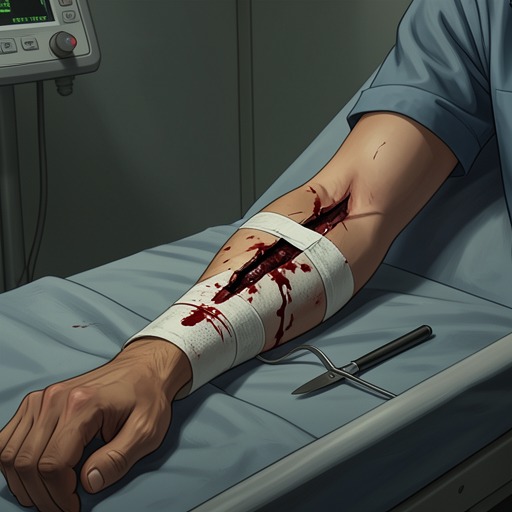
The trip’s imagined purpose also shifts under pressure. They had treated the drive as a short business venture, but the distance makes it an irreversible commitment: they have passed the point at which returning is a simple choice. Both want to turn back, yet neither suggests it. Harry’s arm becomes so painful that he can barely sit still. When he rolls up his sleeve, a large greenish-white swelling surrounds the hole, with red streaks spreading toward his shoulder and wrist. The physical evidence of infection is no longer something he can put off until they get home.
Hostility and Arrest
At a small gas station, Harry asks to use the men’s room and is told it is out of order. The attendant greets another customer warmly, while the mechanic comes out, stares at Harry, and spits. Harry’s pain and confusion begin to harden into rage, but Tyrone urges him to leave. They drive away without resolving the confrontation, already anxious about the gas gauge and aware that they cannot afford to lose access to fuel. Their exchange identifies the hostility as part of what they encounter in the American South, not merely an isolated inconvenience on a safe journey.
The danger becomes explicit when police take them into custody. A cop demands to know where Harry is from, strikes him, and handles his infected arm roughly. Harry identifies the Bronx and New York; the officer responds with racialized abuse directed at New York drug users, including Harry as a white addict. He grabs Harry by the injured arm, cuffs him, and takes him to the car, where Tyrone is already handcuffed. At the station, Harry asks for a doctor, but the booking officer laughs and says medical attention can wait. The trip has now delivered the pair into a system that treats Harry’s worsening injury not as an emergency but as an occasion for further humiliation.
Consequences and Significance
The promised Miami connection never resolves the shortage. Instead, Harry and Tyrone are sentenced to three months on a work gang, longer than the few weeks they had expected. Their passage from the road to forced labor is marked by the same combination of drug dependence and physical vulnerability that shaped the drive. Harry is in severe pain from the arm infection; Tyrone, deprived of Heroin, suffers withdrawal while being made to work.
Tyrone’s experience on the work gang extends the trip’s racial violence beyond the arrest. During the first week, cramps, diarrhea, and repeated retching leave him collapsing from exhaustion. Guards mock his suffering, kick or haul him upright, and make clear their hostility toward New Yorkers. The journey that began with the hope of reaching a drug supply therefore ends, for Tyrone, in a labor camp where withdrawal is intensified by abuse and compulsory work.
The trip’s dramatic reversal lies in the distance between its sales pitch and its actual cost. Harry imagines that a drive south will let the pair get ahead of the shortage and return with money, drugs, and control. The road instead exposes how little control they possess: their route depends on an uncertain connection, their bodies depend on repeated injections, and the infected arm makes every mile more dangerous. Their arrest converts a scheme to evade the street-level crisis into a new confinement, while the abuse that follows shows that crossing into the South brings dangers they had scarcely accounted for. The destination is never the freedom they pictured; the attempt to reach it carries them farther into the consequences of their addiction.